| |
No, it’s not Mayberry, but the project touted to pump $2 billion in development and construction fees over the next decade, will certainly change the way we look at neighborhood living. A mixed-use design of housing, retail, and office space combined with hiking trails, pedestrian walks, and bike paths, the Ranch is designed to significantly reduce auto dependence and put 70% of residents within walking distance of all services. The project also has plans for 1700 permanent jobs and 500 construction jobs, ultimately generating more than $20 million in sales tax revenues for Los Angeles and Ventura counties.
"I think the Ranch will serve as a model to how growth can occur in the county," says Guy, an architect who has worked on the Ahmanson project almost since its inception and currently serves as president.
Though the project has won awards for its architectural and environmental design, it has also generated more than its share of controversy. Environmental groups claim that such development will lead to more pollution of air and water, additional traffic on the Ventura Freeway, and destruction of the ecologically sensitive environment.
On a recent visit to the ranch, headquartered in the hills a stone’s throw from the million dollar Mountain View Estates, Guy, along with Tim McGarry, a vice president at Washington Mutual, addressed each of these concerns.
With regard to traffic and pollution, Guy admitted this is one of the most talked about issues. "There are a total of 37,000 external trips that would come out of the project. About half would go toward Warner Center and half would go south of the project."
Plans include the extension of Las Virgines Road and Victory Blvd. In addition, Ahmanson would be putting in more than $14 million in regional transportation improvements.
Will the improvements expand the busy 101 Freeway? Both Tim and Guy conceded that it is still unclear how monies allotted for transportation would be used for freeway expansion, but the variety of housing options, the shuttle transportation system to and from Warner Center, and the multiuse design would reduce auto dependence and shorten commuter time.
Over the next ten years, Warner Center is scheduled to build offices for 18,000 jobs. In addition, this area is expected to receive a major increase in population, not only from immigration but also from the rising birth rate of post-baby boomers.
"Where will these people live?" Guy asked. "I think we have an existing condition here that doesn’t have a housing response." One of the criticisms of the project, though, is that with the rise of housing costs in Ventura and LA county, most of the 3050 homes available will be out of reach for the average worker.
"Eighty percent of the homes are middle to lower in terms of cost so it isn’t just a luxury only kind of project." The wide range of housing includes 774 units of HUD restricted affordable housing. ($150,000-$275,000), each woven into the single-family neighborhoods.
"What we have tried to do in this project was recognize the need for denser housing and pedestrian opportunities."
Surprisingly, the project has permanently established 5 times as much open space as it will develop, yet one of the arguments against the project is the destruction of natural open space.
"First of all, there is quite a bit of open space; if you go down Malibu Canyon there is a whole network of Santa Monica recreation areas which is extensive and very generous. These properties that we placed into public ownership all had other developmental proposals already under way.
"By the time the project is complete, there will have been five acres placed into public ownership for every acre developed."
"So this is a project which in effect has caused a significant expansion of the park systems in Southern California and is at the same time building a community."
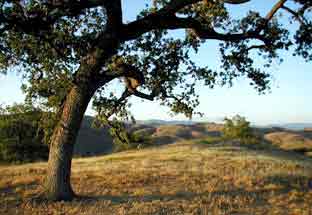
One of the results from a study of the area was the creation of a nonprofit institute called the Las Virgines Institute designed to monitor during construction and in perpetuity the environmental management of the area’s natural resources, which include spine flowers, red legged frogs, oaks trees, grasslands, wetlands and archeological sites.
"It’s an important project," Guy told us, proudly, "and there isn’t one solution or there isn’t one thing not to do. It’s an integrated process. The point is that we need to decide what kind of city we want to have instead of what we are going to try to exclude. It’s a difficult path."
The Ventura County Board of Supervisors plans to vote on Phase A in September or October. If it is passed, construction will begin in 2003 with the first homes completed by 2005.
We encourage you to email your comments, questions, and opinions to: editor@valleyexaminer.com
|
|